
The Bahamas Marine Mammal Research Organisation (BMMRO) is one of our longest-standing conservation partners. Working out of Abaco and across the entire Bahamian archipelago, BMMRO studies and protects the whales, dolphins, and manatees that live in our waters. We are proud to be a primary funding source for their stranding response program, and each month we share their latest news from the field.
A Familiar Manatee Back in Cherokee
BMMRO maintains the national record of manatee sightings in The Bahamas. It is a long-term dataset built one report at a time, and it is the only reliable way to follow a population this small and this mobile.
During this reporting period, sightings came in from Cherokee, Abaco. One of them was Georgie, a manatee the team knows by name.
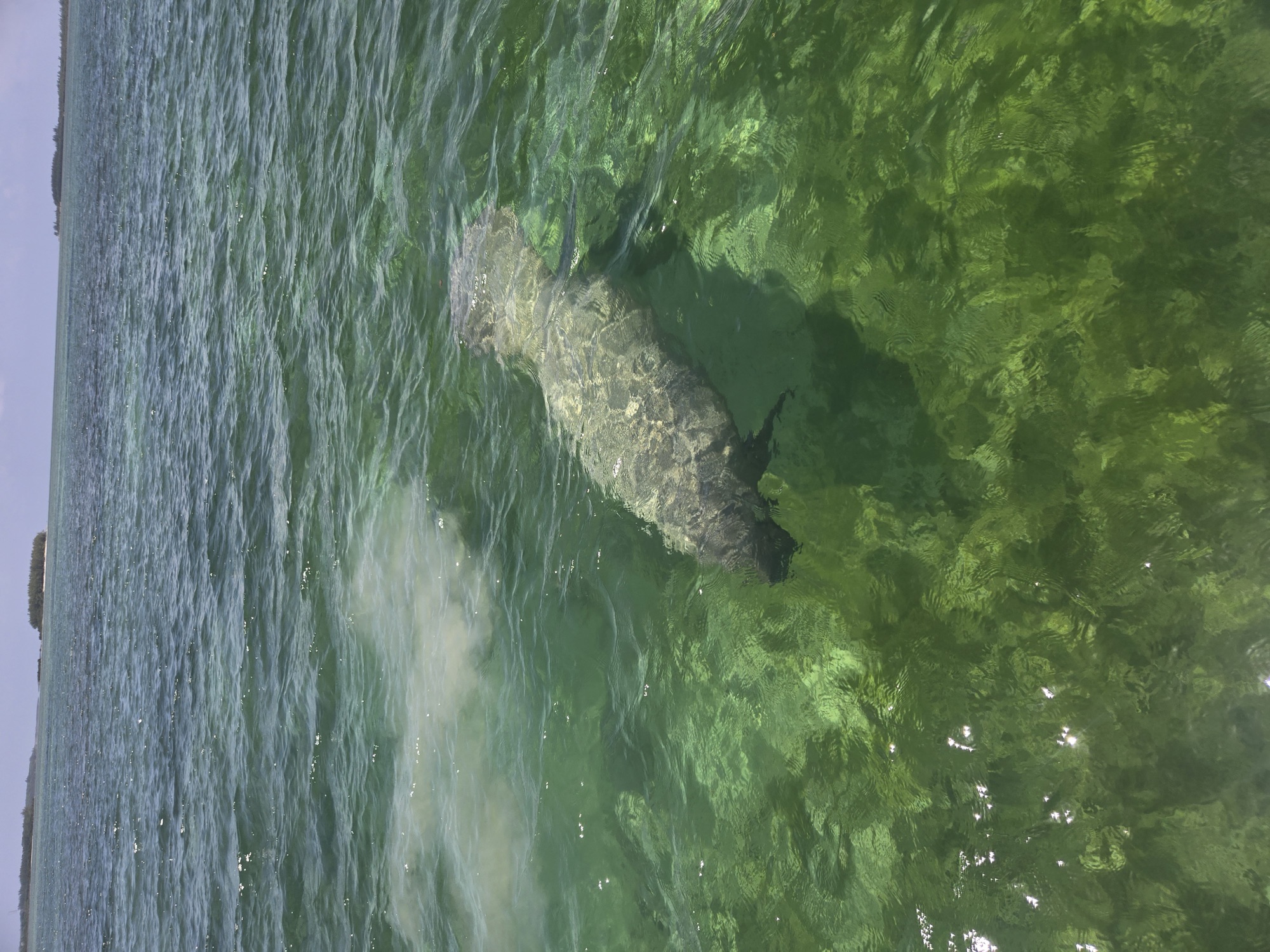
Georgie, photographed in Cherokee, Abaco, in June. Sightings of known individuals let BMMRO track survival, movement, and health over time. Photo: BMMRO.
Georgie first entered the Bahamian manatee record in 2012, when she was released in the Berry Islands as a calf alongside her mother, Rita. Once she was weaned she set off on her own, travelling roughly 200 miles around Abaco before settling at Cherokee, the place she stayed longest on that first journey. More than a decade later, she is still turning up in the same quiet water.
That continuity is exactly what makes individual identification so valuable. The Bahamas is home to only a small manatee population, and animals like Georgie, known by sight and documented again and again, are how researchers measure whether that population is holding on.
Have you seen a manatee? Report it to BMMRO at bahamaswhales.org or on WhatsApp at (242) 462-7923. If you can, include a photo or video along with the date, time, location, and number of animals. That is what turns a nice moment on the water into usable science.
Regatta Season Becomes an Outreach Opportunity
Research protects animals only if the people sharing the water know they are there. This season, Regattas in The Abacos (RITA) named BMMRO one of its conservation partners, which put marine mammal guidance in front of exactly the right audience: sailors, race crews, and spectator boats crossing the Sea of Abaco all summer.
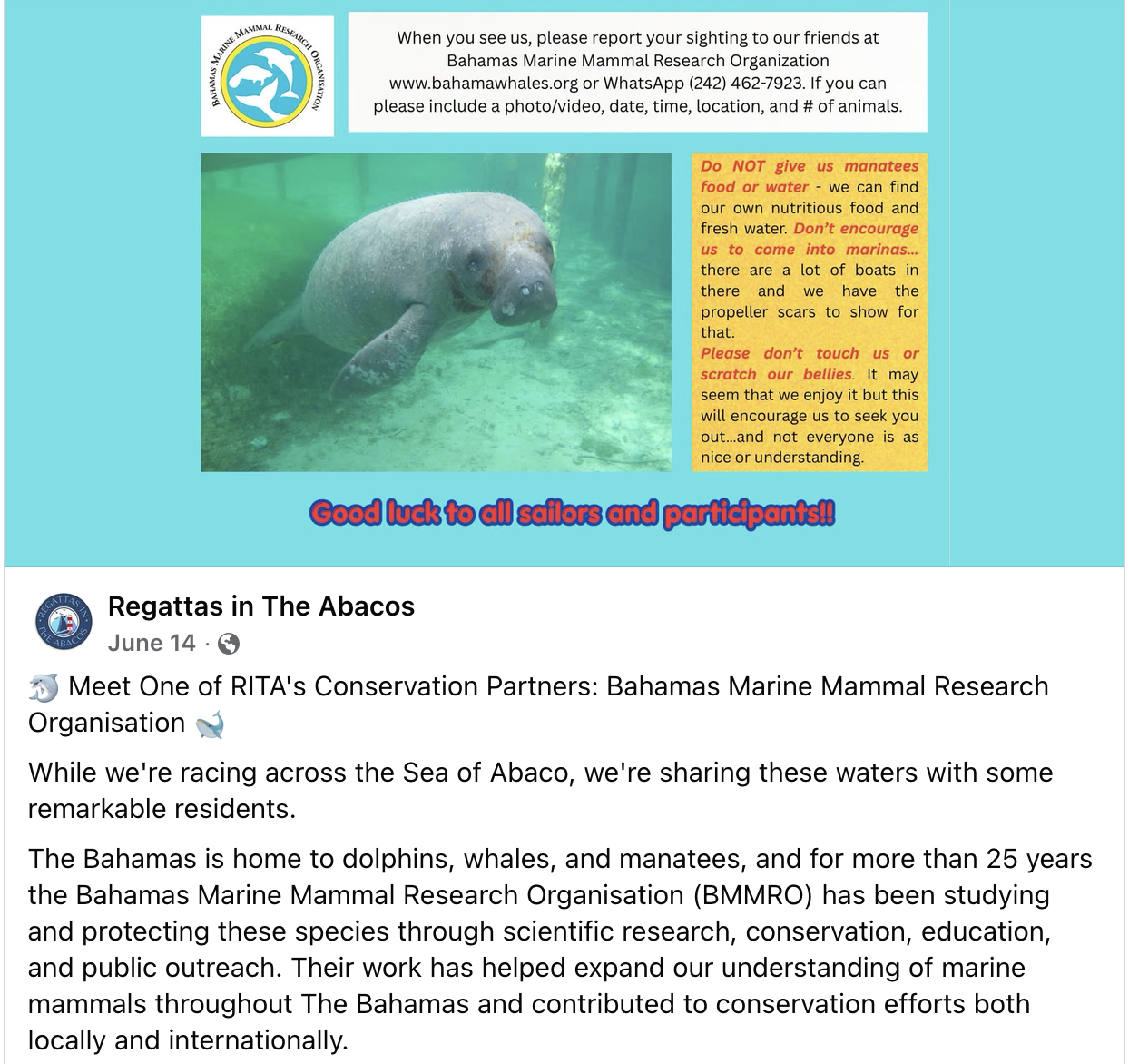
Regattas in The Abacos introduced BMMRO to its followers as a conservation partner, along with guidance on how to behave around manatees. Image: Regattas in The Abacos.
"While we're racing across the Sea of Abaco, we're sharing these waters with some remarkable residents," RITA told its followers, before introducing BMMRO's work to a fleet of people who spend their days on exactly that water.
It is a small partnership with an outsized reach. A regatta fleet covers far more of the Sea of Abaco in a weekend than any research vessel can, and the crews on board are often the first to spot something worth reporting.
How to Share the Water With a Manatee
Manatees are slow, curious, and drawn to people, and that combination is what gets them hurt. BMMRO's guidance to the regatta fleet was short and worth repeating:
- Do not feed manatees or offer them fresh water. They can find both on their own, and feeding teaches them to approach boats and people.
- Do not encourage them into marinas. Marinas are full of propellers, and manatees carry the scars to prove it.
- Do not touch them or scratch their bellies. It may look like they enjoy it, but it teaches them to seek out humans, and not every human they meet will be careful.
Every one of those comes down to the same thing. A manatee that has learned to approach people is a manatee at risk.
Why Your Reports Matter
The Bahamas has no research vessel patrolling every cay. What it has instead is people: boaters, fishers, dock hands, race crews, and residents who notice something unusual and pick up the phone.
Those reports are the backbone of the national sighting record. They tell BMMRO which animals are still alive, where they are feeding, whether a calf has appeared, and whether an animal is showing signs of injury or distress. A single well-documented sighting, with a date, a location, and a clear photograph, can be worth weeks of survey effort.
The same applies to strandings. If you find a marine mammal that is stranded, sick, or injured anywhere in The Bahamas, call BMMRO's 24-hour hotline at (242) 462-7923 right away, and please do not try to move the animal yourself.
About BMMRO and the Atlantis Blue Project Foundation
BMMRO has been studying and protecting cetaceans and manatees in The Bahamas since 1991, working from a field station at Sandy Point, Abaco. Their work spans long-term population surveys of beaked whales, the national manatee sighting record, and the national marine mammal stranding network, and it underpins much of what we know about the more than 25 marine mammal species found in Bahamian waters.
We are proud to fund BMMRO's stranding response program and ongoing research. When a dolphin, whale, or manatee is in distress anywhere in The Bahamas, a call goes out to BMMRO and to the Atlantis Stranding Response Team. Together we cover the cost of transport, equipment, medical supplies, and lab work so that no stranding goes unanswered.
From the deep-diving whales offshore to the manatees in our shallows, the goal is the same: keep The Bahamas a safe place to be a marine mammal.
Help us protect marine mammals in The Bahamas.
Donate at blueprojectatlantis.org | Learn more about BMMRO at bahamaswhales.org