
The Bahamas Marine Mammal Research Organisation (BMMRO) is one of our longest-standing conservation partners. Based in Abaco and working across the entire Bahamian archipelago, BMMRO monitors and protects the whales, dolphins, and manatees that inhabit our waters. We’re proud to be a primary funding source for their stranding response work, and we’re pleased to share their latest update from the field.
Manatee Sightings: Cold Waters Raise Concern
BMMRO has had very few manatee sightings in recent months, and their team is concerned. Water temperatures across The Bahamas have been unusually cold this season, and that’s worrying news for manatees.
West Indian manatees don’t have the thick insulating blubber that many other marine mammals rely on. They depend on warm, shallow coastal waters to keep their body temperature stable. When the water gets too cold, manatees can develop cold stress syndrome, which weakens their immune system and can become life-threatening if they can’t find warmer water.
The most recent confirmed sighting was a single individual spotted near Elbow Cay, Abaco, in December 2025. The Bahamas is home to only a small and fragile manatee population, so every sighting counts.
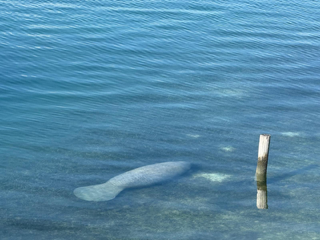
A manatee surfaces in the shallow waters off Elbow Cay, Abaco, December 2025. With unusually cold temperatures this season, BMMRO is asking the public to report any manatee sightings across The Bahamas. Photo: BMMRO.
Have you spotted a manatee? Please report your sighting to BMMRO at bahamaswhales.org or call (242) 366-4155. Even a quick sighting helps researchers track the health and movement of our manatees.
Rare Whale Stranding on Rum Cay
On January 21, 2026, an adult male Gervais’ beaked whale (Mesoplodon europaeus) was found stranded and deceased on the shore of Rum Cay. We extend our sincere thanks to Mr. Craig Gaitor for promptly reporting the stranding and providing excellent photographs.
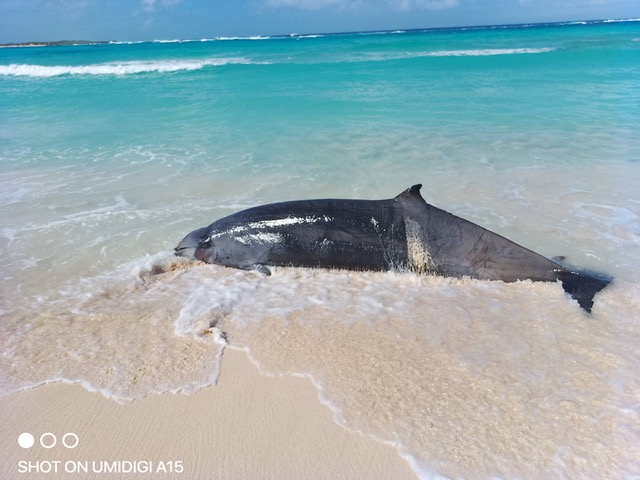
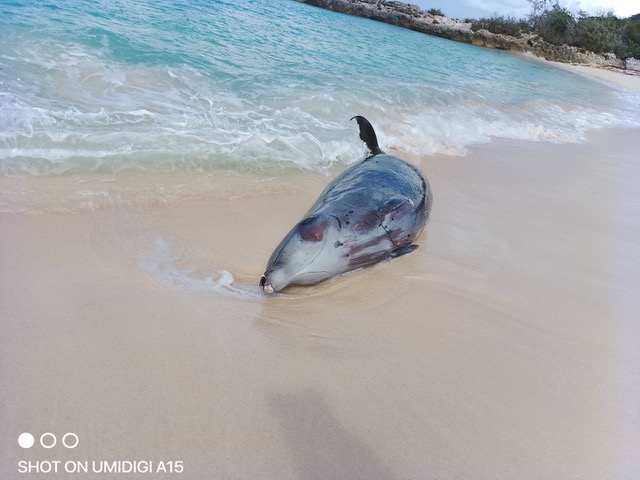
A stranded adult male Gervais’ beaked whale on the shore of Rum Cay, January 2026. This deep-diving species is rarely seen alive, and stranding events provide some of the only opportunities for scientists to study them. Photo: Craig Gaitor / BMMRO.
Gervais’ beaked whales are one of the least understood whale species in the world. They live in deep, warm Atlantic waters and spend most of their time far below the surface, making them almost impossible to observe at sea. Strandings on only one or two occasions per year in The Bahamas on average, and most of what scientists know about these animals has been learned from stranding events just like this one. The species is currently listed as “Data Deficient” by the International Union for Conservation of Nature (IUCN), meaning there simply isn’t enough information yet to assess their population.
Rapid Response: Necropsy and Sample Collection
BMMRO moved quickly to coordinate a response. After helping the Rum Cay team secure the carcass, BMMRO’s Deputy Director and southern Bahamas point person, Felice Major, traveled to the island to conduct a necropsy (a post-mortem examination) the following day. She was joined by volunteers Darryl Major and Chrysanthea Cartwright, an aspiring veterinarian.
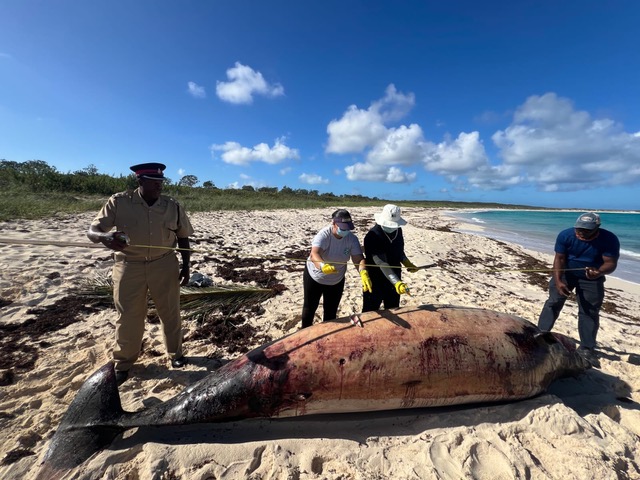
Image Caption: BMMRO Deputy Director Felice Major and volunteers conduct a necropsy on the stranded Gervais’ beaked whale, Rum Cay, January 2026. Samples collected during the examination have been sent to Dolphin Cay at Atlantis for laboratory analysis. Photo: BMMRO.
The necropsy was completed successfully, though no external indicators were found to determine the cause of death. Biological samples were carefully collected and sent to Dolphin Cay at Atlantis, Paradise Island, for final processing, storage, and laboratory analysis. Results from these samples may tell us more about the animal’s health, diet, and any exposure to disease or environmental stressors.
We are grateful to everyone who made this rapid response possible: Donna Vernon, Craig Gaitor, Susie, ASP Gaitor, David Knowles (Chief Councilor), Jerome Cash (Department of Environmental Health), and the veterinary team at Dolphin Cay, including Linda Hammerton, Dr. Deandra Delaney-Milfort, and Dr. Julianna DeHass. Thank you also to everyone who reported the stranding and offered support.
Why Reporting a Stranding Matters
Strandings are sad events, but they are also some of the most important opportunities we have to learn about the marine mammals in our waters. Many of these species live their entire lives far offshore and deep below the surface, so a stranding may be the only chance scientists get to study them up close.
From a single stranding response, researchers can determine an animal’s age, sex, and reproductive condition. They can examine stomach contents to learn what the animal was eating and test tissue samples for disease, parasites, or pollution. Over time, this data builds a bigger picture of population health, species distribution, and the overall condition of our marine ecosystems.
For a species like the Gervais’ beaked whale, where so little is known, every single data point helps fill critical gaps. Stranding patterns can also act as an early warning system, flagging emerging threats like disease outbreaks or the effects of ocean noise.
Found a stranded, sick, or injured marine mammal? Contact BMMRO right away at (242) 366-4155 or visit bahamaswhales.org. Please don’t try to move the animal yourself. Your report could save a life and help advance the science that protects marine life across The Bahamas.
About BMMRO and the Atlantis Blue Project Foundation
The Bahamas Marine Mammal Research Organisation has been studying and protecting cetaceans and manatees in The Bahamas for more than 20 years. From long-term population surveys of beaked whales off Abaco to running the national marine mammal stranding network, their work is essential to understanding the more than 25 marine mammal species found in Bahamian waters.
We are proud to fund BMMRO’s stranding response program and ongoing research. When a dolphin, whale, or manatee is in distress anywhere in The Bahamas, a call goes out to BMMRO and to Atlantis’ Stranding Response Team. Together, we cover the costs of transport, equipment, medical supplies, and lab work so that no stranding goes unanswered.
Together, we’re working to make sure The Bahamas stays a safe haven for marine mammals, from the deep-diving beaked whales of the open ocean to the gentle manatees of our coastal shallows.
Help us protect marine mammals in The Bahamas.
Donate at blueprojectatlantis.org | Learn more about BMMRO at bahamaswhales.org