
Blue project Stories
Love is in the water with coral spawning season upon us!
Co-written by Silia Woodside (Cape Eleuthera Institute) & Natalie Hurtado (Cape Eleuthera Institute)
Every summer once the water temperature increases, several reef creatures know it is the time of the year to produce some offspring by releasing their reproductive cells or gametes (females called eggs and males called sperm) into the water column. Corals in particular are sessile animals that can’t move to find mates, so they synchronize their spawning cycles with different environmental cues like water temperature, sunset time and moon phases.
What is coral spawning?
Corals have the capability to increase their size and to regenerate after breaking by reproducing asexually, but they also can develop sexual cells known as gametes. By releasing them, they can form new colonies and maintain their genetic diversity through sexual reproduction, commonly referred to as coral spawning. Sexually produced offspring can provide the coral with resistance to environmental stressors and diseases, leading to more resilient reefs in the future.
Some coral species can produce eggs and sperm within the same colony and are known as Hermaphroditic broadcast spawners, they release their gametes in bundles that can vary in size and color (light pink to brown) depending on the species. When the bundles are released from the coral, they float up to the surface where the wave action breaks them apart, releasing the sperm and egg and allowing them to cross fertilize with the gametes of other colonies. Other coral species have separate sexes and are known as Gonochoric broadcast spawners; they release eggs and sperm independently, the eggs being similar to the gamete bundles but much smaller. The sperm is released in bursts from the coral and looks similar to rising smoke. Once released from the colonies, the sperm and egg can meet and combine in the water column.
In order to increase their chances of cross fertilization with other coral colonies, corals synchronize the release of their gametes in mass spawning events, where multiple colonies will all release their gametes at the same time. Because these reproductive events may occur annually and are linked to water temperature, sunset and the lunar cycle, they can then be used to make coral spawning predictions.
Previous
Next
Common Caribbean corals releasing gametes (i.e., bundles of eggs and sperm) at night.
How do we know when corals may spawn?
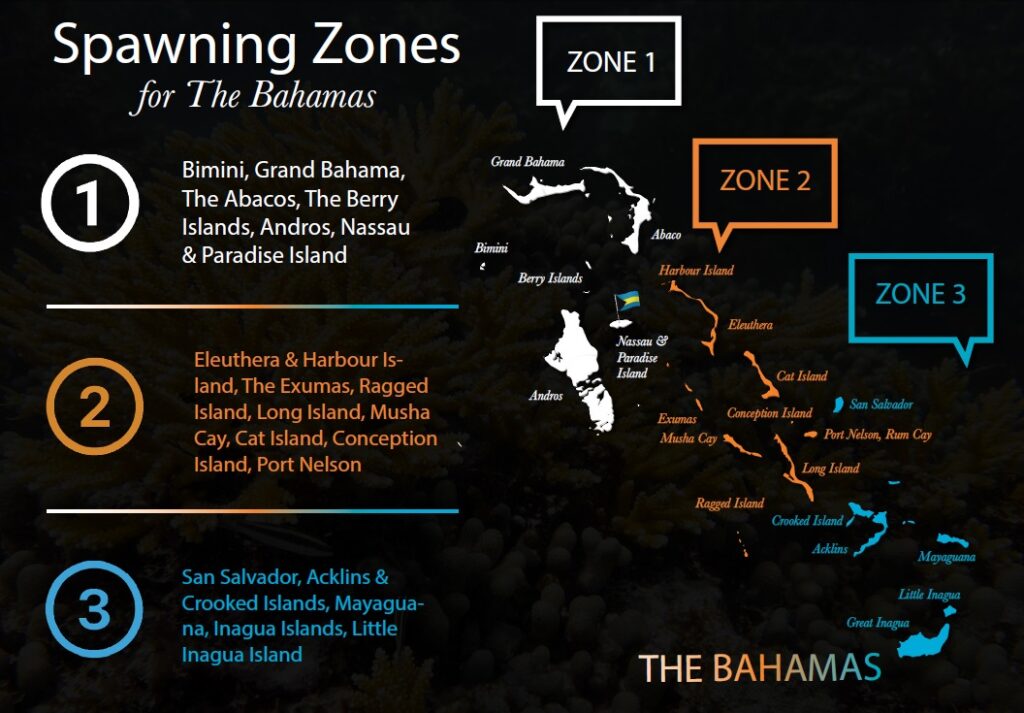
Researchers in the Caribbean have been witnessing mass spawning events on the reef and developing predictions for when different coral species will spawn. During the summer months when the water begins to get warmer, beginning as early as April to as late as October, the corals will use the change in water temperature as an indicator to spawn. The process is then triggered by the full moon followed by the setting of the sun. In The Bahamas, an archipelago of over 700 islands and cays spread out over 500 miles, the sunset differs depending on the island. As part of creating the spawning predictions, The Bahamas was separated into three distinct zones that are based on the time of sunset. Knowing the exact time of the sunset is crucial to determining when one can witness a coral spawn, as a ten minute window can make all the difference, especially while diving.
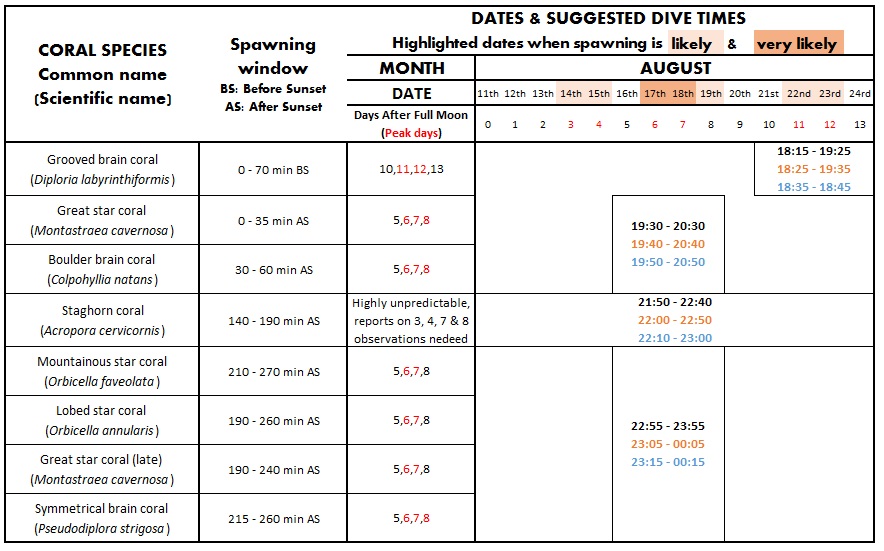
Depending on the species, the days following the full moon and the time around sunset, spawning could vary. For example, Mountainous star coral, Orbicella faveolata, a key reef building species in the Caribbean, has been known to spawn between five to eight days after the full moon and between 210 and 270 minutes after the sunset, in the months of August and September. Another dominant reef building species is the grooved brain coral, Diploria labyrinthiformis, that has been found to release its gametes between 10 to 13 days after the full moon up to 70 minutes before sunset, the only species so far known to do so, usually all summer long starting in April.
Relevant information of key Caribbean species, months and times were compiled in a booklet that contains field photographs and a table with dates and times when spawning could be observed. The booklet was created by Researchers working at the Cape Eleuthera Institute (CEI) at The Island School and the Perry Institute for Marine Science (PIMS), as part of The Bahamas Coral Innovation Hub project; Natalia Hurtado (CEI & PIMS), Lily Haines (PIMS) and Silia Woodside (CEI). These researchers made the predictions as an educational tool to help local scientists, grassroots nonprofits, dive organizations and volunteers work together to repopulate coral reefs across the region using larval propagation techniques.
Why is this information important?
The Bahamas relies heavily on its natural resources to attract tourists to its shores year after year, generating its main source of income. For these natural resources, The Bahamas has coral reefs to thank. Coral reefs provide benefits to the Bahamian livelihoods, such as providing sand for our beautiful beaches as well as providing a habitat to many economically important species like the spiny lobster and Nassau grouper. However, coral reefs have steadily been in decline over the past few decades, mainly due to effects of climate change, such as rising sea temperatures and ocean acidification, as well as overfishing and a variety of coral diseases. Nowadays, many coral restoration efforts have sparked, with the hope of facilitating reef rehabilitation. In South Eleuthera, The Bahamas Coral Innovation Hub (BCIH) team based at The Island School has been working with several coral restoration techniques, using their reproductive strategies to increase reef repopulation efforts.
Larval propagation is a coral restoration technique that takes advantage of the coral’s natural sexual reproduction by collecting their gametes and rearing them into juvenile corals in a lab setting. Using this method is highly beneficial as it increases the genetic diversity of the resulting coral offspring by cross fertilizing the gametes of different coral colonies.
Coral spawning remains difficult to predict and the information does not guarantee that spawning will occur. We are really interested in conducting more spawning observations throughout The Bahamas to advance our knowledge and restoration techniques. Collecting gametes and rearing them until they are juvenile corals will increase their chances of survival. Once they are back on the reef, the juvenile specimens are more likely to produce healthy resilient coral reefs that can continue to provide ecosystem services for years to come.
The Atlantis Blue Project Foundation (ABPF) has been a leader in supporting marine conservation efforts in The Bahamas for over a decade. One of our proudest achievements to date is our financing of the first-ever Bahamian workshop on coral restoration in Cape Eleuthera, using the larval propagation techniques outlined above.
This is a project of the Atlantis Blue Project Foundation.