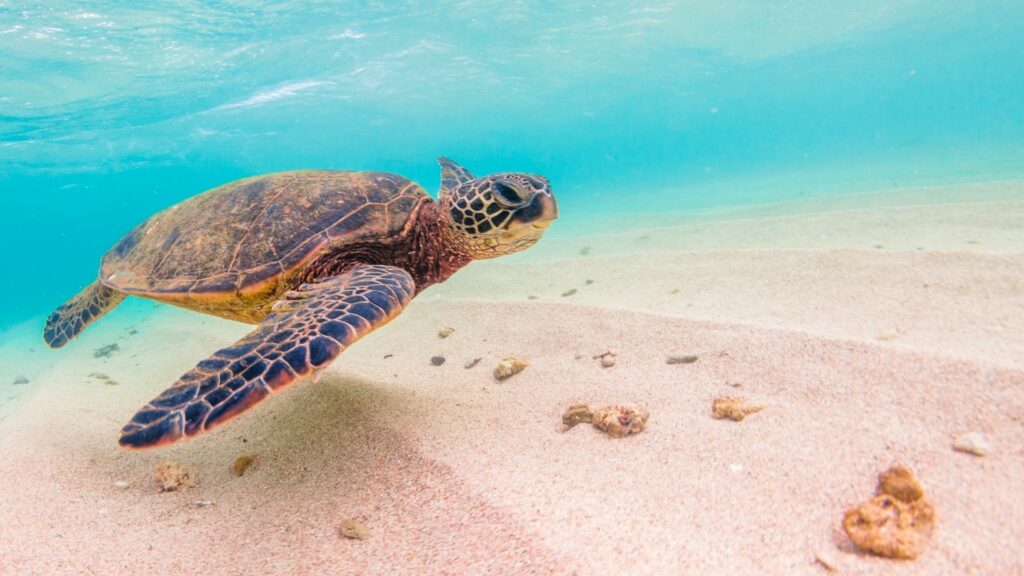
Historically, green turtles were harvested for their meat which has led to lower population sizes globally. In response to this, the Bahamian government passed a law that gave “full protection to all marine turtles found in Bahamian waters by prohibiting the harvesting, possession, purchase, and sale of turtles, their parts, and eggs” in September of 2009. This incredible win for sea turtles was not the first step Bahamians had taken in the fight to protect them. For over 30 years, the Bahamas National Trust, Bahamas Reef Environment Educational Foundation, The Nature Conservancy Caribbean and the Atlantis Blue Project Foundation have been working to improve protection for green sea turtles.
As mentioned previously, green sea turtles feed on seagrass beds. Seagrass beds are highly sensitive to changes in water quality and thus these marvellous ecosystems can be highly indicative of the environmental condition that exists around them. The Perry Institute of Marine Science, another key partner of the Atlantis Blue Project, conducts rapid ecological assessments (REAs) of the seagrass meadows to better inform the restoration and management of these ecosystem, which helps provide crucial habitat for green sea turtles.